Queue Management System in Pakistan vs the Gulf: A 2026 Rollout Playbook
If you run branches on both sides of the Arabian Sea, you already know that a queue management system in Pakistan behaves differently from one in the Gulf. The technology is similar, but the deployment realities — power stability, language, staffing culture and budget expectations — diverge sharply. This playbook maps those differences so a regional operations lead can plan one coherent rollout instead of two disconnected projects.
Rather than repeat generic marketing claims, this article draws on how mid-sized banks, telecom franchises and public offices actually stand up queuing across these markets in 2026.
Why Regional Context Changes the Queuing Blueprint
A queue platform is only as good as its fit with local operating conditions. In Karachi or Lahore, intermittent grid power pushes teams toward on-premise servers with UPS backup and offline resilience. In Riyadh or Dammam, reliable infrastructure makes cloud-first designs attractive and cheaper to scale.
Language shapes the interface too. Gulf deployments lead with Arabic and right-to-left displays; Pakistani branches often blend Urdu and English on the same ticket. Getting these details right early prevents an expensive redesign later.
Staffing culture affects counter design
High-touch service norms in South Asia mean supervisors want fine-grained control to transfer, prioritise and escalate visitors. A rigid, one-button system frustrates floor managers. Flexibility beats simplicity here.
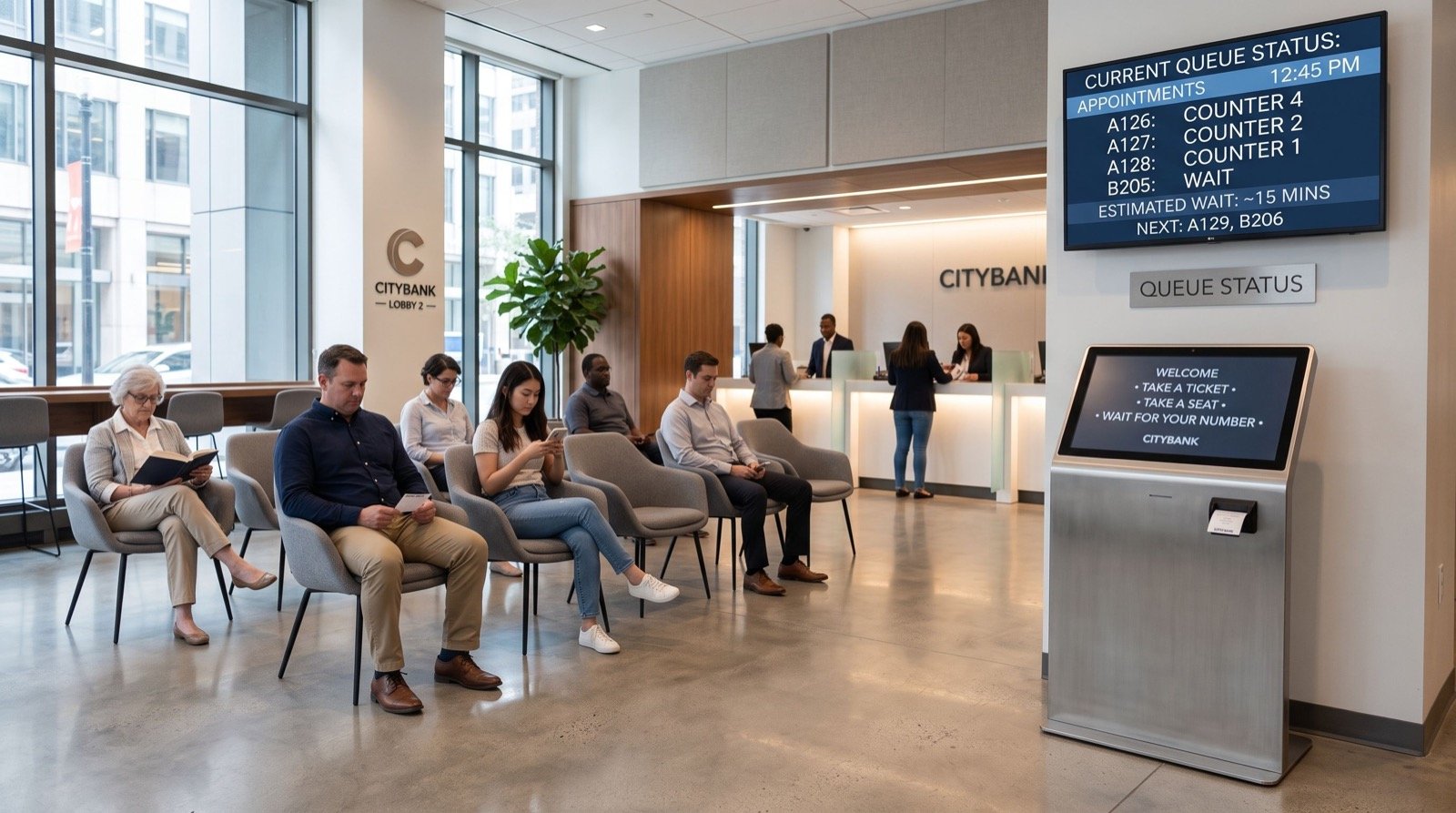
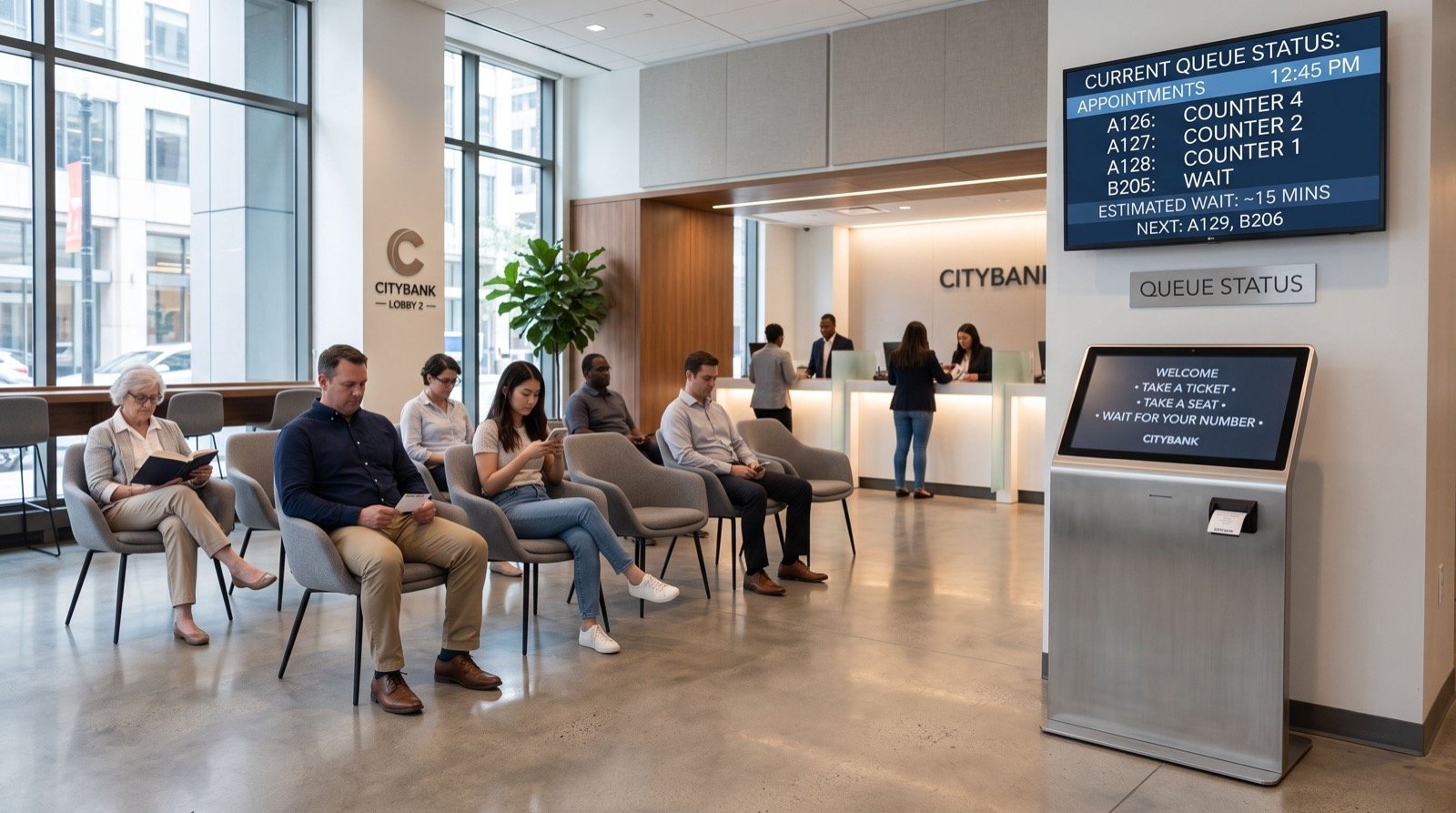
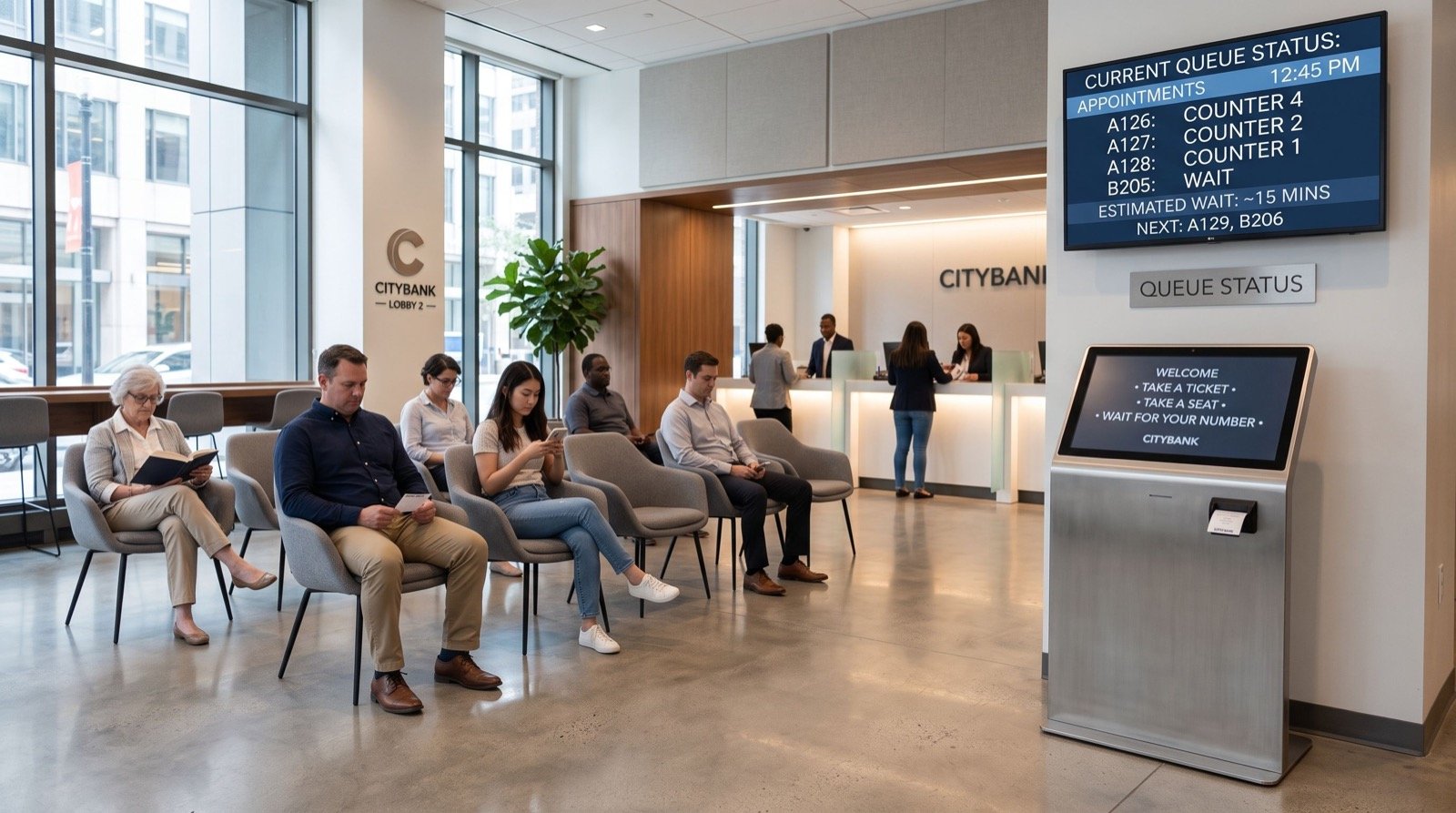
Gulf branches, by contrast, often prize polished self-service. Customers expect a tidy kiosk, a clear Arabic display and an SMS that lets them leave the branch and return near their turn. Designing for these expectations from the outset avoids retrofitting later, and it signals to visitors that the brand respects their time.
What a Queue Management System in Pakistan Must Handle
Local conditions set a demanding baseline. A queue management system in pakistan should keep issuing and calling tickets during load-shedding, run on modest hardware, and support bilingual prompts without add-on licences.
It should also survive spotty connectivity. If a branch loses internet for an hour, the local server must continue serving and then reconcile reports centrally once the link returns. Anything less risks a queue collapse at the worst possible moment.
Cost sensitivity shapes the buying pattern too. Pakistani operators frequently prefer modular purchasing — start with ticketing and displays, then add SMS notifications and appointment booking once the basics prove their worth. A vendor who forces an all-or-nothing bundle rarely wins here. The smarter suppliers let a branch grow its feature set gradually, which keeps early budgets realistic and builds internal confidence before the next investment.
Local support presence is another decisive factor. When a display fails in Faisalabad, a supplier with an engineer nearby resolves it in hours, not days. Head office should weigh this on-ground reach as heavily as the software feature list, because downtime at the counter is far more visible to customers than any missing dashboard chart.
How Does Gulf Deployment Differ From South Asia?
The single biggest divergence is hosting strategy. Stable power and connectivity let Gulf operators lean into cloud dashboards that unify dozens of branches in real time. A robust queue management system in saudi arabia typically ships with cloud analytics, appointment booking and SMS notifications as standard rather than optional extras.
Compliance also weighs heavier in the Gulf, where data residency and privacy expectations are formalising quickly. Vendors there increasingly host within-region to satisfy regulators, a factor that rarely blocks a Pakistani rollout today but is worth designing for.
Side-by-Side: Deployment Priorities by Market
| Priority | Pakistan | Gulf (KSA/UAE) |
|---|---|---|
| Power resilience | Critical — UPS + offline mode | Standard grid, less critical |
| Preferred hosting | On-premise / hybrid | Cloud-first |
| Primary languages | Urdu + English | Arabic + English |
| Budget sensitivity | High — modular buying | Moderate — feature-rich |
| Data residency | Emerging concern | Formal requirement |
Read this table as a planning checklist rather than a rule. Many operators run a hybrid model in Pakistan and a pure cloud model in the Gulf, unified by one reporting standard so head office compares apples to apples.
Building One Cost Model Across Two Markets
Finance teams stumble when they price each region in isolation. A smarter approach standardises the cost categories, then adjusts the numbers per market.
- Hardware — kiosks, displays, printers, and UPS units (heavier in Pakistan).
- Software licences — per counter or per branch, ideally the same vendor both sides.
- Connectivity — SMS gateways and internet redundancy.
- Services — installation, training and annual support.
Standardising vendors across regions unlocks volume pricing and a single support relationship. It also means your Karachi and Riyadh dashboards speak the same language, literally and in data terms.
Measuring success the same way everywhere
Pick four shared KPIs — average wait, service time, abandonment and peak load — and hold every branch to them. Industry bodies such as the ITU digital development statistics underline how consistent measurement, not one-off tools, drives service improvement across regions.
Choosing a Partner Who Understands Both Sides
Few suppliers genuinely operate across Pakistan and the Gulf with equal depth. The right partner will survey your power and connectivity realities in each city, not assume Riyadh conditions apply in Multan.
A disciplined cross-border rollout usually follows the same sequence in both markets:
- Survey each pilot branch for power, connectivity and language needs.
- Configure hosting per market — hybrid in Pakistan, cloud in the Gulf.
- Pilot one branch per country and measure the four shared KPIs.
- Standardise the winning setup and negotiate volume pricing.
- Scale branch by branch, comparing every site against the same benchmark.
Ask for a phased plan: pilot one branch per market, prove the KPIs, then scale. Engaging reliable local experts who have shipped in both environments dramatically lowers the risk of a stalled cross-border rollout.
Insist on a written support matrix that spells out response times per city. A partner covering Riyadh brilliantly but leaving Lahore to a third party will create uneven service that head office feels every month. Consistency of support, not just consistency of software, is what makes a two-market network feel like one organisation.
Watch, too, for the temptation to over-engineer the Gulf sites and under-serve the Pakistani ones, or the reverse. Each market deserves a design tuned to its conditions yet reporting into a shared standard. The best rollouts feel local at the counter and global in the boardroom, and that balance comes from a partner who genuinely respects both environments rather than copying one blueprint everywhere.
Frequently Asked Questions
Can one vendor supply queuing for both Pakistan and the Gulf?
Yes, and it is usually the smarter choice. A single vendor gives you unified dashboards, volume pricing and one support contact, provided they can localise language, hosting and power resilience per market.
Is cloud hosting safe for a queue management system in Pakistan?
Cloud works well where connectivity is stable, but many Pakistani branches choose hybrid setups. A local server handles ticketing during outages while cloud dashboards aggregate reports when the link is up.
How much does a multi-branch rollout cost?
Costs vary with branch count and features, but standardising vendors and hardware across markets typically cuts total spend by consolidating licences and support into one agreement.
Which KPIs prove the system is working?
Track average wait time, average service time, abandonment rate and peak-hour load. Applying the same four metrics in every country lets head office compare branches fairly.
Final Thoughts
Deploying a queue management system in Pakistan and the Gulf under one strategy is entirely achievable in 2026 — but only if you respect the local differences in power, language and hosting. Standardise your vendor, your cost model and your KPIs, then flex the technical details per city. Pilot before you scale, and lean on a partner fluent in both markets. Do that, and two challenging regions become one well-measured, smoothly flowing network.